
Finding ERP Buyers Before They Go Looking
I spent 9,000 credits answering a question that was sitting in job ads for free.

Tim Burnham
Founder
Updated September 4, 2026
What changed: Reordered so the expensive lookup comes before the cheap one, which is the order it actually happened in.
So there I was, having just spent $8.63 scraping LinkedIn to find people who were unhappy with their ERP.
It got me 3 leads.
Better than paying $500 a lead. But I had no idea whether those 3 were worth anything.
Some background
I was building outbound for a company that sells Acumatica, a modern cloud ERP. ERP is the software a company runs its money and operations on. Accounting, inventory, jobs, payroll. The unglamorous stuff that stops everything when it breaks.
People replace it once every 10 or 20 years, because doing it is enormously disruptive. So at any moment, almost nobody is looking.
That is the whole problem. You are not competing for attention. You are trying to find the few people in a very large market who have started to care.
One competing reseller spent half a million dollars on outsourced cold calling last year, at under 1% effectiveness. So nobody has this figured out.
LinkedIn signals, and why they failed here
You can usually find good people through what I would call LinkedIn signals. They are engaging with stuff about your industry. Liking it, commenting, writing it.
That works in most markets. Here is what it got me.
| Where they came from | People | Actual buyers | Sell ERP for a living |
|---|---|---|---|
| Engaged with independent advisors | 692 | 5.1% | 63.0% |
| Found via keyword search | 1,137 | 3.7% | 44.4% |
| Wrote the post themselves | 208 | 2.9% | 79.8% |
Look at the last row. Post authors should be the warmest people on that list. They sat down and wrote about the pain. They are the worst of the three, and it is not close.
A post about "Dynamics GP end of life" is almost never a GP customer asking for help. It is a reseller marketing to GP customers.
People sell ERP every day. They buy it once a decade. So the whole conversation is the industry talking to itself, and no filter fixes that.
So I went to Clay
Stop starting from conversations. Start from companies.
Clay is good at that. You describe the shape of a company and it goes and finds them.
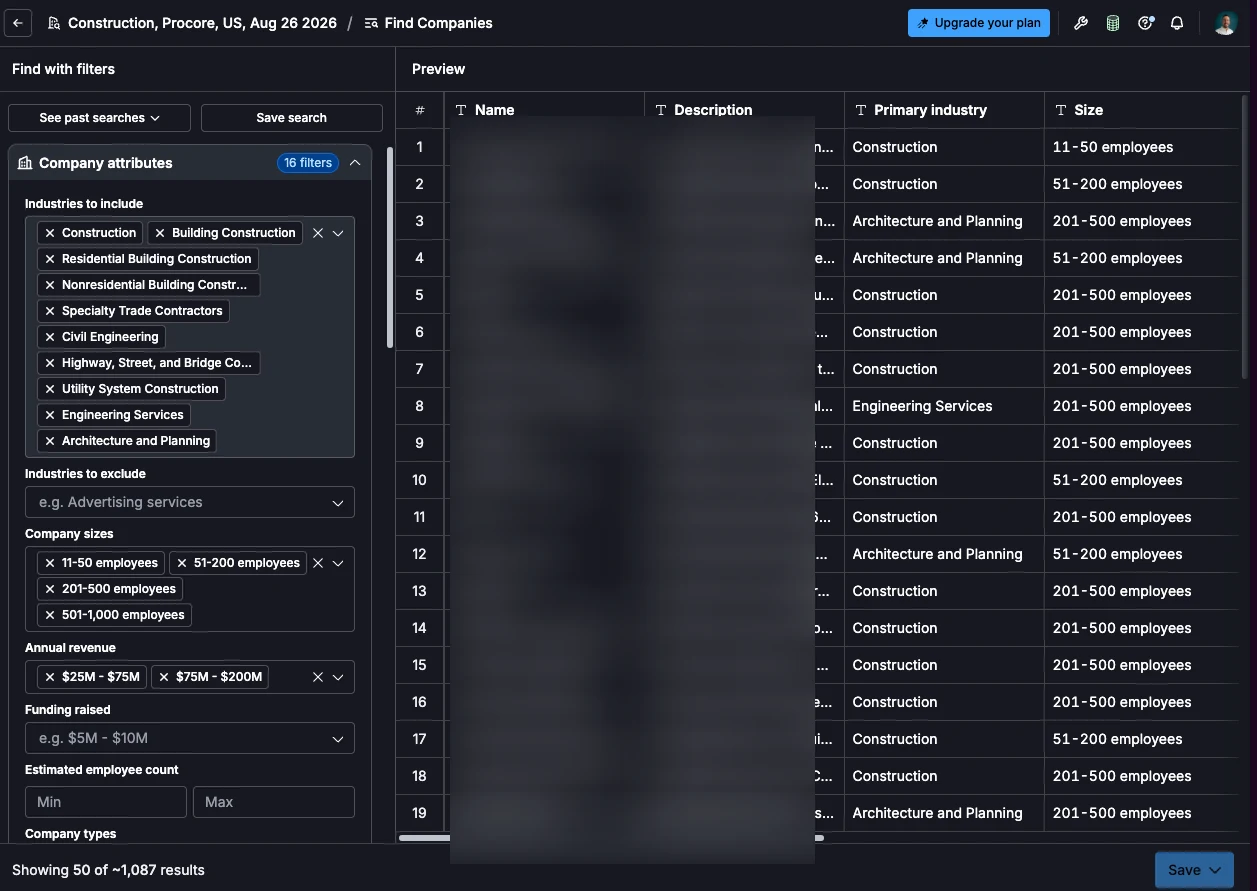
The filter that mattered most was Procore. It is project management software for construction, and running it is a real, checkable fact about a company.
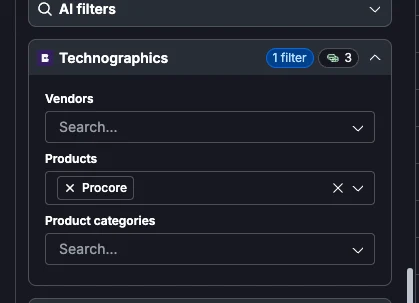
1,087 companies.
Then I spent 9,000 credits finding out what they run
Knowing the company is not enough. I needed to know what ERP each one was already on, because that is what tells you why they might leave.
So I ran all 1,087 through a technographic lookup. About 9 credits each.
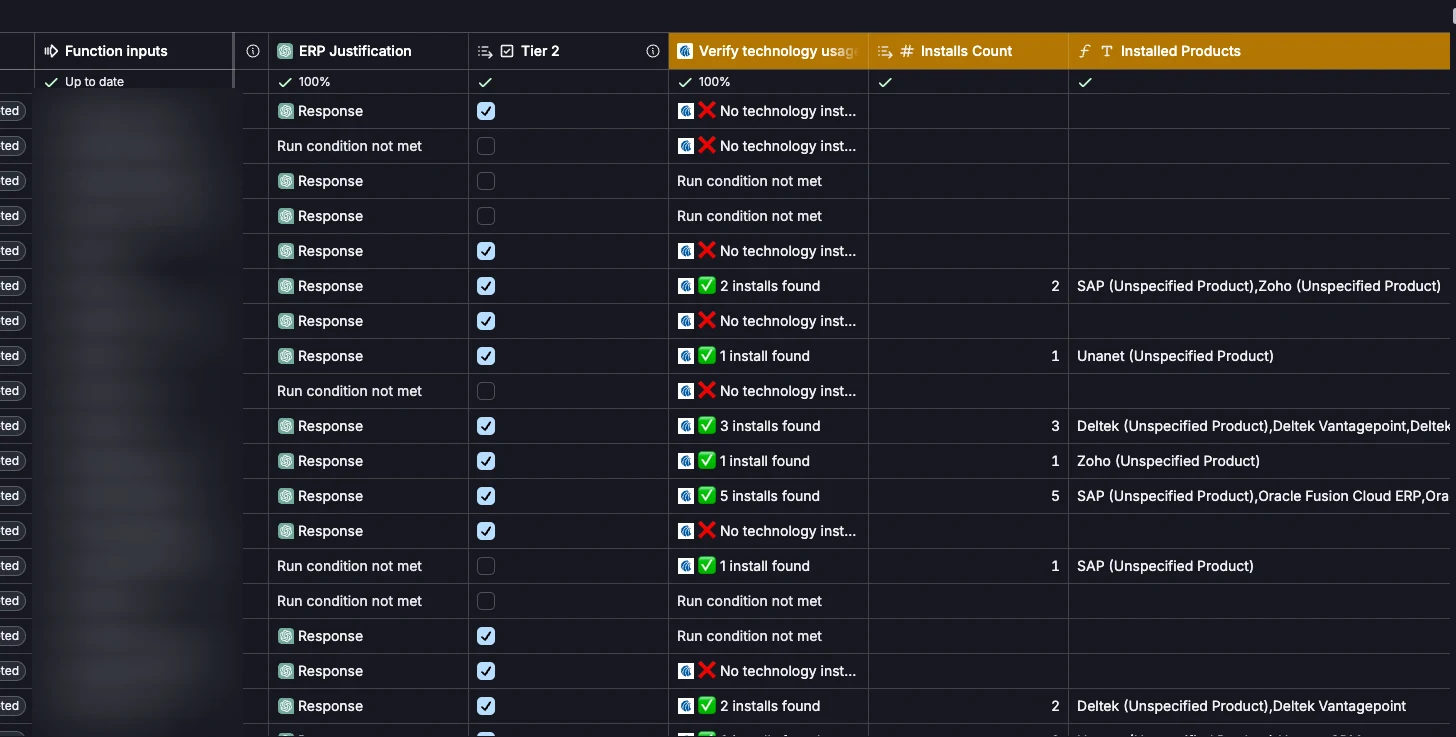
Half came back with nothing. Of the rest: 18% on construction specific systems, 16% on something at end of life, 7% enterprise, 6% modern, 2% already on Acumatica.
Half. On a paid database. What is everybody else running?
I geeked out over that. It was the first time the market looked like anything other than a list.
Then I found out job ads would have told me for free
A job posting that says "strong hands-on experience with Great Plains" proves that company runs Great Plains. Nobody advertises for a system they do not have.
It costs about half a cent to read.
12 search terms, $2.80, 577 postings. Same question I had just paid 9,000 credits to answer. For the price of a coffee.
That one stung a little.
I am not sorry I bought the data. It was fast and it covered companies that were not hiring. But I would run the free version first now, and only pay for what it misses.
The part I did not see coming
Job ads do something the paid data cannot. They tell you when.
The client had described his movable segment as companies where "the owner dies or the son takes over." He said it like it was unfindable.
The words retire and succession appear in 57 of those postings.
The thing he thought was unfindable was a keyword.
I did not know job descriptions carried that, and I have been chewing on it since. A company writes a job ad when something has changed. So what else is in there that I am not reading?
Four segments, because a different system means a different reason to leave
Somebody on a tiny system leaves for reasons that have nothing to do with why somebody on NetSuite leaves. So I sorted by how big their current system is, and gave each one its own thing to look for.
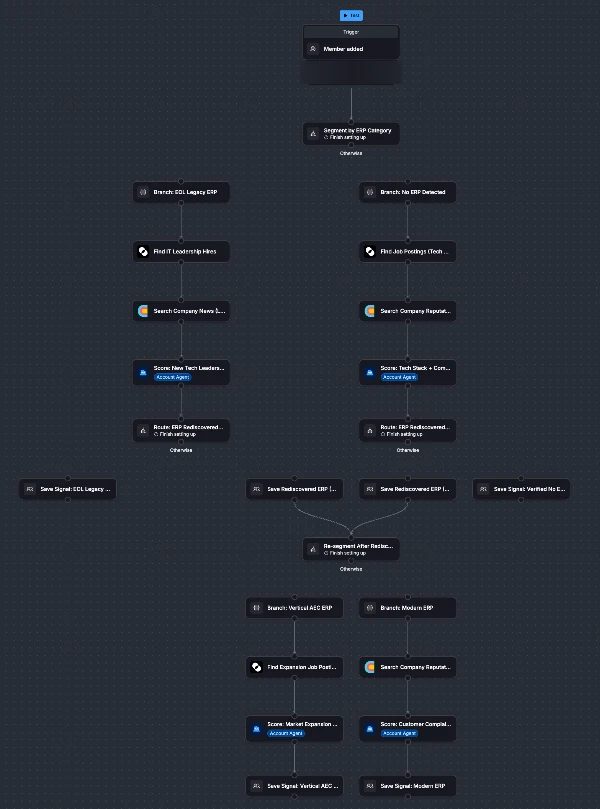
End of life. Published expiration date, so the clock is running. Look for a new CFO or ops leader. A new person is the one who gets to say we are not doing this again.
Industry specific. Very good at one thing. Look for the company moving outside that one thing. New work, or buying a company that does something adjacent.
Modern but broken. Current software that still is not working is an implementation problem. Look for customers complaining about lateness and quality.
That one has a disqualifier built in. If the complaints are about leadership, that says nothing about their ERP. It says people do not like their boss. So lateness counts and management is an anti signal, and the company comes off the list. It fired on 43 of 186.
Nothing on file. Assume that is wrong. I checked the first 10 by hand and 6 of them ran a real named system, sitting in their own job postings.
What I got wrong about scoring
My first model gave the highest score to companies showing signs of migrating.
The client pushed back. If they are already transitioning off, is that not too late?
He was right, and I had built the thing backwards for about a week before anybody said it out loud.
| What the company showed | Share |
|---|---|
| Named a legacy system, no project language | 86% |
| Showed a project, no destination named | 0.2% |
| Named where they were going | 14% |
I used to call that 0.2% the thing I was chasing. A company mid project that has not picked anybody is the textbook perfect prospect. But it is 0.2%. You cannot build anything on it.
What I want is the 86%. People on a dying system who are starting to notice and have not moved yet. That is much harder, because at that stage there is nothing to see.
The 14% turned out to be useful, just not how I expected. They already picked somebody. That is not a lead, it is a reason to skip them, and knowing who not to call is worth something on a small list.
I flipped that score from +4 to -8. The data was always fine. I was the problem.
So what happened
| Companies found | about 1,100 |
| Scored | 272 |
| Real signal | 40 |
| Connection requests sent | 38 |
| Accepted | 3 (7.9%) |
| Replies | 0 |
Lower than I usually see. Personalized outbound like this normally lands 30 to 50% acceptance and about 30% reply on top. I am well under, and I am not going to dress that up.
$21.60 of scraping. Plus the 9,000 credits, which is a lot. Some of the enrichment ran over 40 credits a row.

I should also stop calling this intent data. I know their system, I know it is dying, I know who owns it internally. I do not know they are shopping. That is a weaker claim and I should have said so earlier.
What I am trying next
Company reviews. Somebody writing that the system is old and needs replacing is much closer to a person noticing than a job ad is.
First party data, because anything I collect myself beats anything I can buy.
And the ones I have not thought of yet, which is the honest version. The bet is that some public fact sorts these companies. I have found two.
Age is not the obstacle here. Genericness is. A 40 year old market has job ads, review sites, published end of life dates and hiring patterns going back decades. The market that looks hardest to break into is the one leaving the most evidence lying around.
That is the part I believe. The part I have not proven is that any of it converts.
If you have run outbound into a market where people buy once a decade, I would really like to know what worked.
Think I got this wrong?
These are working notes, so I change them when someone shows me something better. If you're building in this space, I'd like to hear about it.
Let's talk