
Will AI Take Our Jobs, or Kill Us All?
A thought experiment I ran with 30 business students in Amsterdam.

Tim Burnham
Founder & CEO
October 10, 2026
Short answer: I don't think AI takes all our jobs. I'm worried about something else, and I'll get to it at the end.
Last week I gave a talk to about 30 second-year students at the Amsterdam School of International Business. The title was "Should we worry more about our lives or our jobs?"
Our goal wasn't to answer the question. It was just to ask it well. Here's how it went.
Can AI really kill us all?
I hate to break it to you, but nobody knows.
Evan Hubinger, who leads alignment science at Anthropic, posted in September that he personally thinks there's a more than 10% chance AI kills all humans within the next decade. That's an oddly specific number.
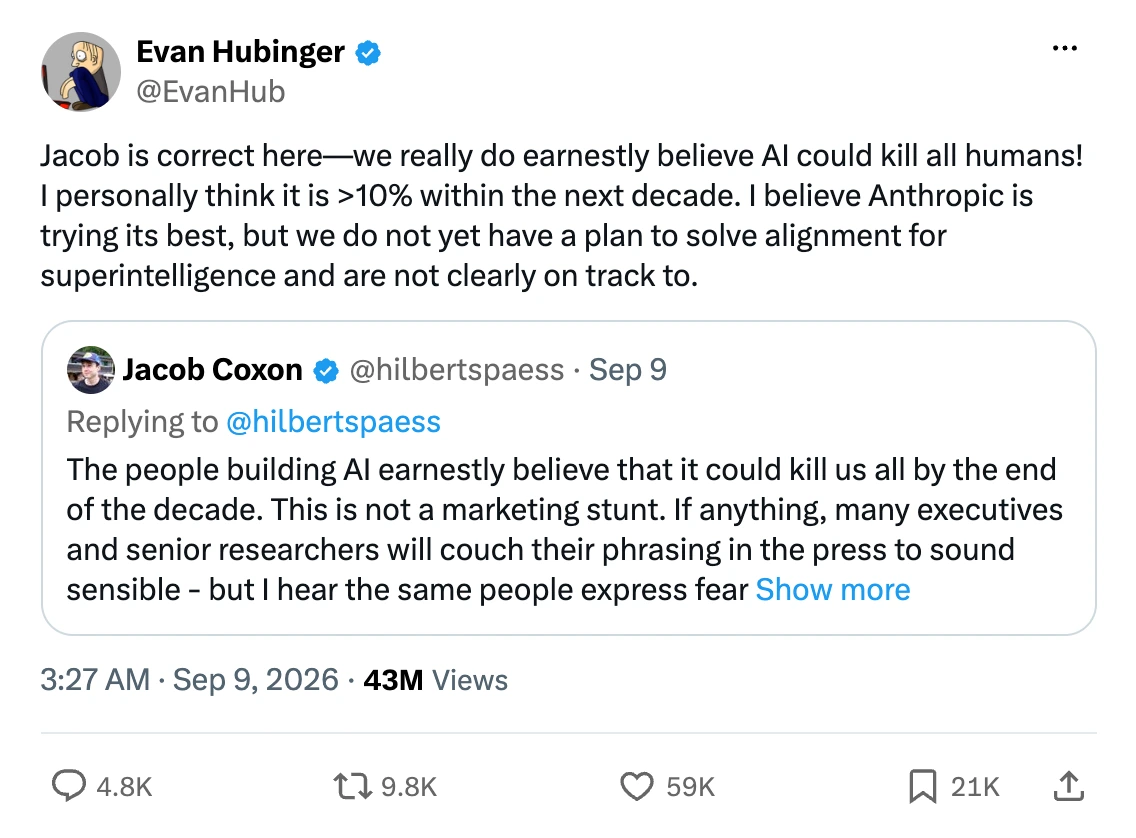
Geoffrey Hinton, who won the Nobel Prize in physics in 2024, said anybody who estimates probabilities like that is just making a wild guess. He also said 10% doesn't seem unreasonable to him. His point was that nobody really knows how to give a sensible estimate.
So I can't tell you who's right. What I can tell you is what technology has done to people before.
What do people do with the time a machine saves them?
Try this one. Say I could wave a wand and give you 3 extra hours a week. What would you do with them?
It's not a made-up question. A study from the 1940s timed the laundry of farm wives. One load took about 4 hours the old way, and 41 minutes with a washing machine.
So where did the time go? Historian Ruth Schwartz Cowan found that housework hours barely dropped. People washed more clothes, more often, and expectations went up. The need for housework was bigger than the time available for it.
Then there's Hans Rosling, who said in a 2010 TED talk that for his mother, the machine meant a trip to the library. So it goes both ways. (Researchers still argue about how much time really came back, because they measured different households.)
We save time, and then we fill it. The open question is what with.
Does new technology create new jobs?
A computer used to be a job. A person sat and did calculations by hand, all day. I don't think anybody wants that job anymore.
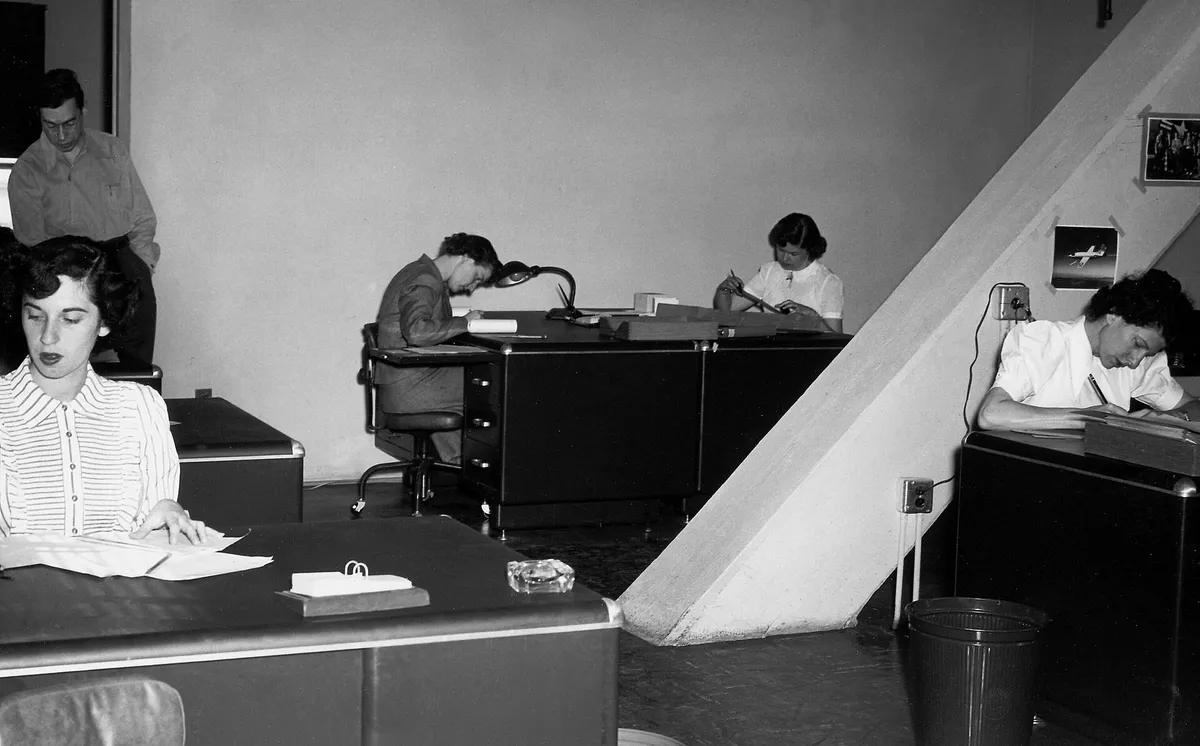
Your phone does roughly 2 trillion calculations a second. If a person does one a second, that's about 260 Earths' worth of people working for you nonstop, including at 2 AM when you're watching cat videos. Think about that.
And about 60% of the work Americans did in 2018 was in job titles that didn't exist in 1940, according to David Autor and his co-authors. If you'd told someone in 1940 their job was going away, they'd have worried. Now we're just as busy as we were then.
Why do we use more of something when it gets cheaper?
How many TVs did your family have growing up? Probably one. Now there's a TV, a phone, a laptop and an iPad.
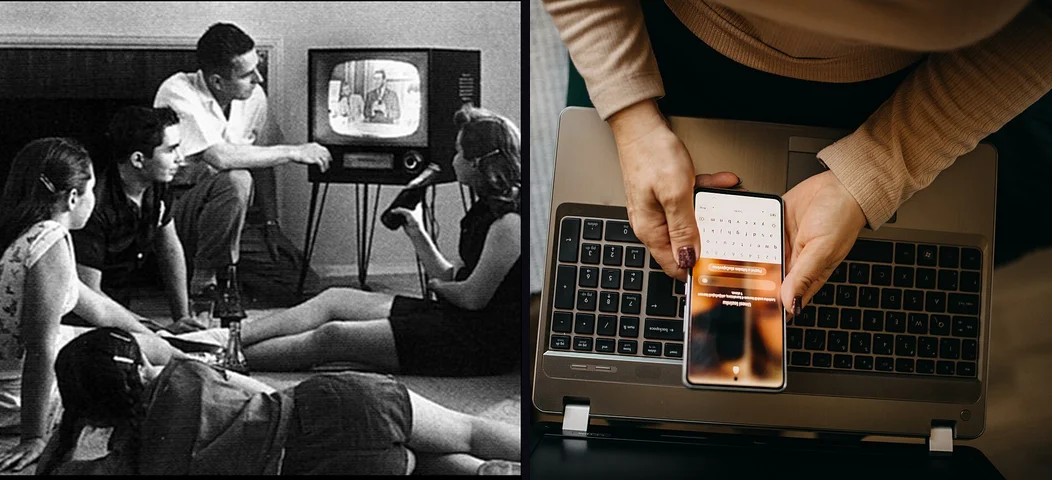
Why? Because it got cheaper. When you can only afford one screen, you want one. When you can afford three, you buy three.
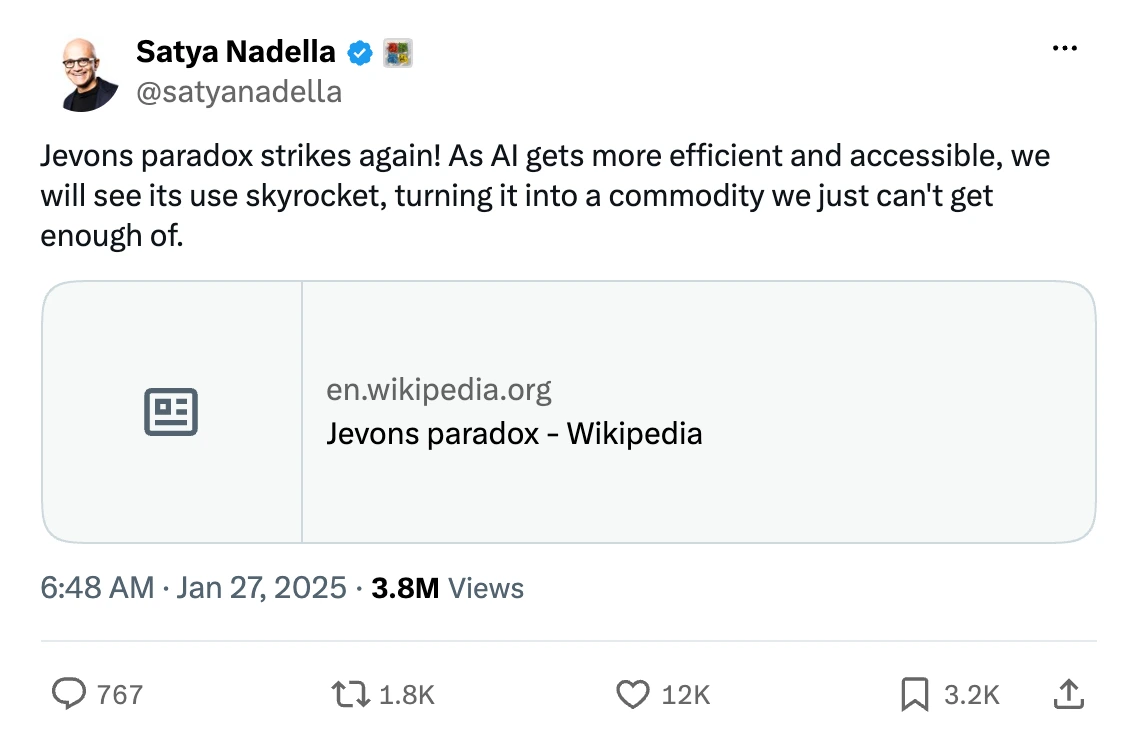
Economists call this the Jevons paradox. In 1865, William Stanley Jevons noticed that using coal more efficiently made Britain burn more coal, not less. Satya Nadella posted the same thing about AI in January 2025: "Jevons paradox strikes again!"
Washing machines did it too. In 1911 an electric washer cost about 553 hours of an average factory worker's pay. By 1997 it cost 26 hours. Washers got cheaper and people washed more clothes.
So that's the pattern I keep running into. Time saved gets filled. New work shows up that nobody imagined. And cheaper means we want more.
What is a GTM engineer?
My own job is an example. A go-to-market (GTM) engineer uses AI to help a company sell more and sell faster. The title is only about 3 years old, and Clay helped popularize it. I run AI Ascend, where I build these systems for sales teams. (I wrote more about how to hire one.)
Here's why the job exists. A salesperson used to research companies by hand, about 15 minutes each. Maybe 1 in 3 was a good fit. So that's roughly 45 minutes to find one good company, before you've found the right person or written a single email. And most people don't reply.
Now you can teach an AI to do the research and rank the companies. It can run thousands at once, watch the news and LinkedIn for buying signals, and hand a salesperson a short list every morning.
The salespeople who like talking to people get to talk to people. The people who like building systems build them. AI took the part of the job salespeople didn't want and gave it to a new kind of role.
There's a catch. Once everyone has this, everyone hits the same people at the same time, and standing out gets harder. So you need more AI to find angles nobody else has, which means more demand for people who can do that. Granted, I'm biased.
Could AI take every job?
Let's go to the extreme and say it does. That assumes two things.
One, AI can do every job, including every new job we create to manage AI. Two, we've run out of ideas, and humans can't come up with anything new.
I don't buy either one. From my experience we've never been limited by our imagination. We've been limited by our ability to execute. A lot of jobs are people talking to people, or people trying something nobody has tried, and AI isn't very good at that yet. I might be wrong.
So what should we worry about?
The real danger, I think, is that AI makes life so easy that we stop thinking.
Social media already does a version of this. It figures out what you're interested in and serves it up so you stay, and so they can advertise to you. Now picture relying on AI for everything. How do I think about this? What do I do about this relationship? It tells you, and you get used to asking. At some point it's your boss.
I'm worried less about AI leaving us with nothing to do, and more about us letting it decide what to do instead.
And that brings us back to the washing machine. AI is going to give us time. We can find comfort and do more of the same, or we can reinvest it in learning and building.
At university I studied fluids and calculus, and I haven't used either since. What I kept was how to learn quickly, how to work with people, and how to get out of my comfort zone. That's why I have a company. I learn something, then help people who haven't had the time to.
Anyways, that's the thought experiment. I don't know if it's right. What do you think we should worry about?
FAQ
Will AI take my job?
Probably not all of it, but it will change it. Technology has repeatedly saved time, created jobs nobody imagined (about 60% of US work in 2018 was in titles that didn't exist in 1940), and gotten cheaper, so we wanted more. The bigger risk is relying on AI so much that you stop thinking for yourself.
Could AI kill us all?
Nobody knows. Anthropic's Evan Hubinger puts the chance at more than 10% within a decade. Geoffrey Hinton says anyone giving a number is making a wild guess, though he doesn't find 10% unreasonable. Experts disagree, and the honest answer is uncertainty.
What should I do with the time AI saves me?
Spend at least some of it learning and building. When a machine saves time, people tend to fill it with more of the same. The people who put it into new skills end up with something to show for it.
What is a GTM engineer?
A go-to-market engineer uses AI and automation to help a company sell more and sell faster. They build the systems that research companies, find the right people and flag buying signals, so salespeople spend their time talking to buyers. The title is about 3 years old.
Sources
- Evan Hubinger, post on X, 9 Sep 2026.
- Geoffrey Hinton on CNN's The Lead with Jake Tapper, transcript, 12 Aug 2026, and Business Insider, 10 Sep 2026.
- Greenwood, Seshadri and Yorukoglu, "Engines of Liberation", Review of Economic Studies, 2005 (the 4 hours vs 41 minutes laundry study).
- Ruth Schwartz Cowan, More Work for Mother, 1983.
- Hans Rosling, "The magic washing machine", TEDWomen, 2010.
- Autor, Chin, Salomons and Seegmiller, "New Frontiers: The Origins and Content of New Work, 1940-2018", Quarterly Journal of Economics, 2024.
- William Stanley Jevons, The Coal Question, 1865.
- Satya Nadella, post on X, 27 Jan 2025.
- Cox and Alm, "Time Well Spent", Federal Reserve Bank of Dallas, 1997 (553 hours in 1911, 26 hours in 1997).
- Phone math is my own: about 2.15 trillion operations a second on an iPhone 15 Pro GPU, divided by 8.2 billion people (UN, 2024), assuming one calculation a second per person.
Working on something like this? Tell us what's slow and we'll tell you what we'd build.